
A good monthly report should make some of last month’s analysis obsolete.
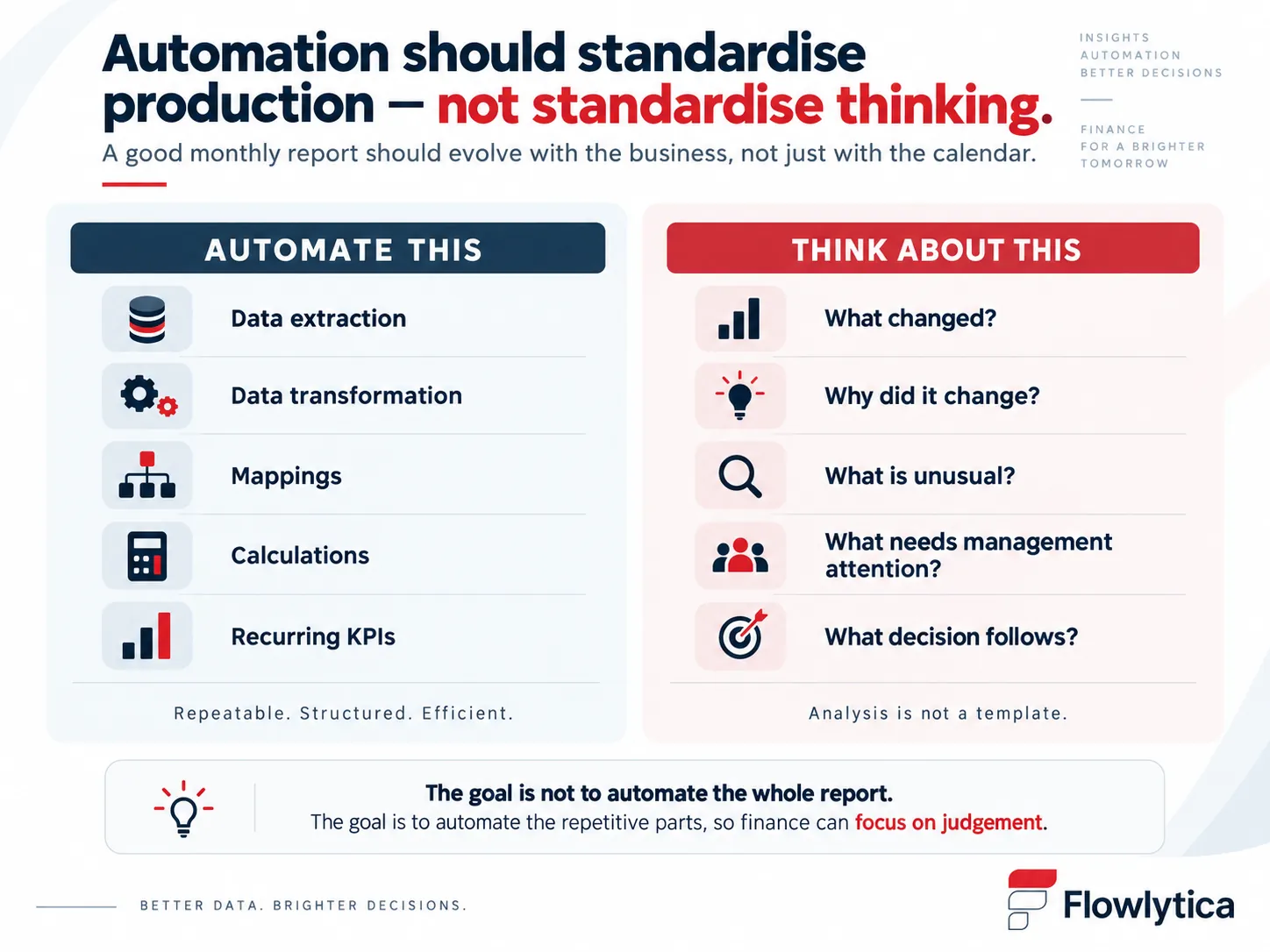
Automate the recurring reporting work, then use the time saved to investigate what changed. A monthly report should evolve with the business.
That sounds counterintuitive.
Finance teams often treat consistency as the goal: same pack, same KPIs, same variance tables, every month.
Consistency is useful for measurement.
But management reporting has another job: direct attention to what matters now.
If freight costs suddenly become material, they may deserve their own analysis.
If customer mix is driving margin deterioration, a standard revenue-vs-budget chart probably isn’t enough.
If working capital is stable again, perhaps it no longer needs three pages of commentary.
This is one reason I’m skeptical of the idea that management reporting can ever be completely “finished.”
Automate the recurring backbone: data extraction, transformations, mappings, calculations and standard KPIs.
Then use the time you saved to investigate what changed.
Automation should standardise production — not standardise thinking.
Otherwise, you risk producing the same excellent report every month while the questions management needs answered have already changed.
Does your monthly report evolve with the business, or only with the calendar?